Customer Review Sites That Influence Your AI Mentions — and Why Star Ratings Don’t Always Matter
Your online reputation can make or break your success–and since it's mainly influenced by online reviews, you should be present on top review platforms!

Key takeaways
- Uberall’s research across five verticals shows that review volume is a stronger predictor of AI mentions than star ratings in most categories, with hotels as the notable exception
- The platform that matters most isn’t the same across every industry — Yelp predicts AI visibility for restaurants and grocery, Zocdoc for dental practices, TrustPilot for retail banking, and Google Business Profile for hotels
- Managing reviews across 15+ consumer review websites without a centralized inbox means slower response times, missed complaints, and no way to compare sentiment across locations
"Making your Google rating and number of reviews visible on your crawlable local page as well as including a few relevant review examples with dates matters. That, along with appropriate local business schema, creates structured data that is far easier for AI models to retrieve than reviews locked inside third-party platforms."

If I asked a marketing lead at a restaurant group which review platforms they manage, I'd happily bet on hearing something like the following: "Of course, Google, then Yelp …" followed by a brief pause.
OpenTable would pop up in the conversation because it drives reservations. TripAdvisor would get a mention because the lead has decided they should probably be responding there too. Then they would throw in Bing, Apple, Facebook for good measure — after all, customers are already leaving feedback on those platforms, even if no one from the team owns the responses there.
Every brand knows Google matters. They’re confident that two or three other platforms also matter, and they're on the fence about some other review websites. Since you can't be everywhere at once, the obvious multi-location review strategy is to master one review platform and generate outstanding star ratings there before tackling the others, right?
Our answer is "no." Not when important customer feedback is sitting on platforms nobody on the team is checking. A customer complaint on TripAdvisor that nobody responds to still gets read by the AI models that ChatGPT, Google AI Overviews, and Perplexity use to decide which businesses to recommend. Uberall’s AI Visibility Research across five verticals also found that review volume, not star ratings, predicts most of the time whether AI models mention your brand.
Here are the platforms worth prioritizing, organized by category, and why each one is a source of operational intelligence and AI visibility — not just a profile to throw in the mix.
You Don’t Need Good Star Ratings to Be Recommended by AI
You can read about key AI data sources in our article. I'll just summarize here.
ChatGPT, Gemini, and Perplexity pull from a mix of training data and live web results when generating business recommendations. But they rarely have access to the actual text of your reviews. What they can see is review metadata: How many reviews you have, how recent they are, and your average rating.
Some models pick up limited snippets or themes from Google and Yelp, but for most platforms the review content itself sits behind walls the models can’t crawl. That's why review count and recency are such powerful AI review signals — they're the information that’s actually available.
This is why Katya points out:
{{quote}}
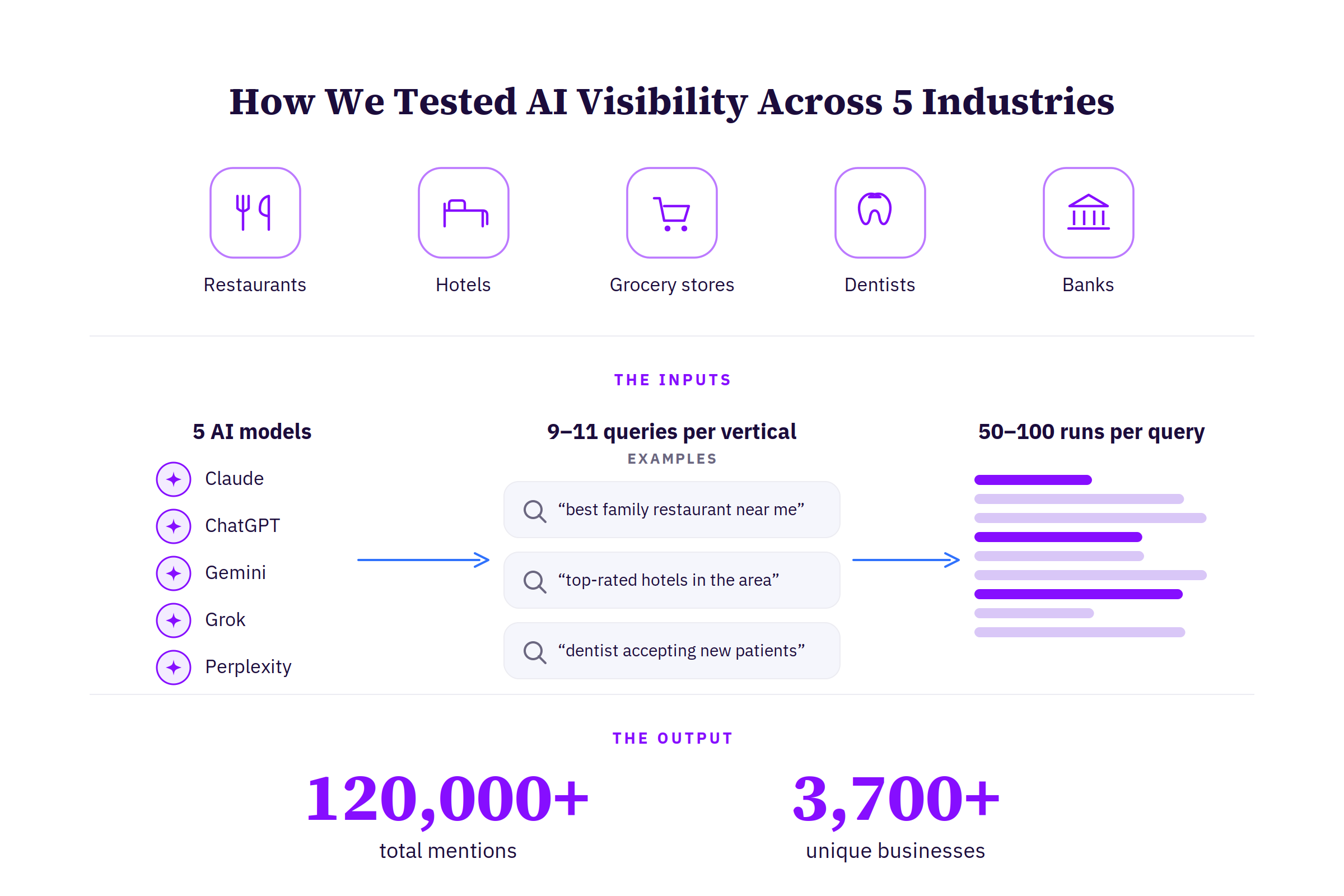
Our GEO/SEO Analyst Katya Shishchenko set out to measure exactly how much this matters. She ran five independent studies across five business categories — testing all five AI frontier models across 9 to 11 prompts each, with 50 to 100 runs per combination. That’s over 120,000 mentions analyzed. To break down just how many locations were tested:
- Grocery (1,007 in Chicago)
- Hotels (275 in New York City)
- Banking (247 in Charlotte)
- Dental (1,627 in Chicago)
- Restaurants (567 in Los Angeles)
In four of the five verticals studied, review volume was a stronger predictor of AI mentions than star ratings.
- Grocery brands: Brands with high review volume but lower ratings get AI mentions more than 94% of the time. Brands with high ratings but low volume get mentioned just under 61% of the time.
- Restaurant brands: Every star-rating category — including one-star reviews — was a positive predictor of AI mentions, because what mattered was total volume, not the score.
- Dental brands: No platform’s star rating reached statistical significance across five separate review platforms. The difference between being mentioned and not came down to review count — mentioned practices averaged 643 reviews versus 253 for those AI models never mentioned.
- Banking brands: The banks AI models mention most often happen to have lower Yelp and TrustPilot star ratings. Those banks get mentioned because they dominate training data through review volume and other AI mention influences.
- *EXCEPTION* Hotel brands: A hotel’s GBP star rating was a stronger predictor of AI mentions than its review count — the only vertical where that was the case. On OTA platforms like Booking.com and Expedia, review volume actually correlated negatively with AI mentions, meaning more OTA reviews didn’t translate into more AI recommendations.
It’s not that star ratings are irrelevant. The difference in review volume between mentioned and nonmentioned brands in AI responses is far bigger than the difference in star ratings. A dental practice with 1,500 reviews and a 4.4 rating is more likely to be mentioned than one with 20 reviews and a 4.7 rating.
Star ratings are thus not always the star of the show, and multi-location brands need to find a way of encouraging more customers to leave reviews across platforms if they want to be recommended by ChatGPT and friends.
Stop caring only about collecting positive customer reviews. A high volume of mixed-sentiment reviews tells you and AI systems more about how customers really feel about your business than a small number of five-star ratings. Rather than soliciting reviews against the guidelines of several platforms, including Google, your on-site team must have this review generation process nailed.
Where Should I Be Collecting Reviews in Volume?
For multi-location brands trying to figure out which review sites for businesses actually influence AI visibility, Katya’s study highlights which are most influential, so multi-location teams should be looking to keep an active flow of reviews here.
The platforms that matter changes according to business category, too, meaning the review platform mix you need for maximum AI visibility isn’t the same across every category.
By including this table we're telling you where to start, not where to stop.
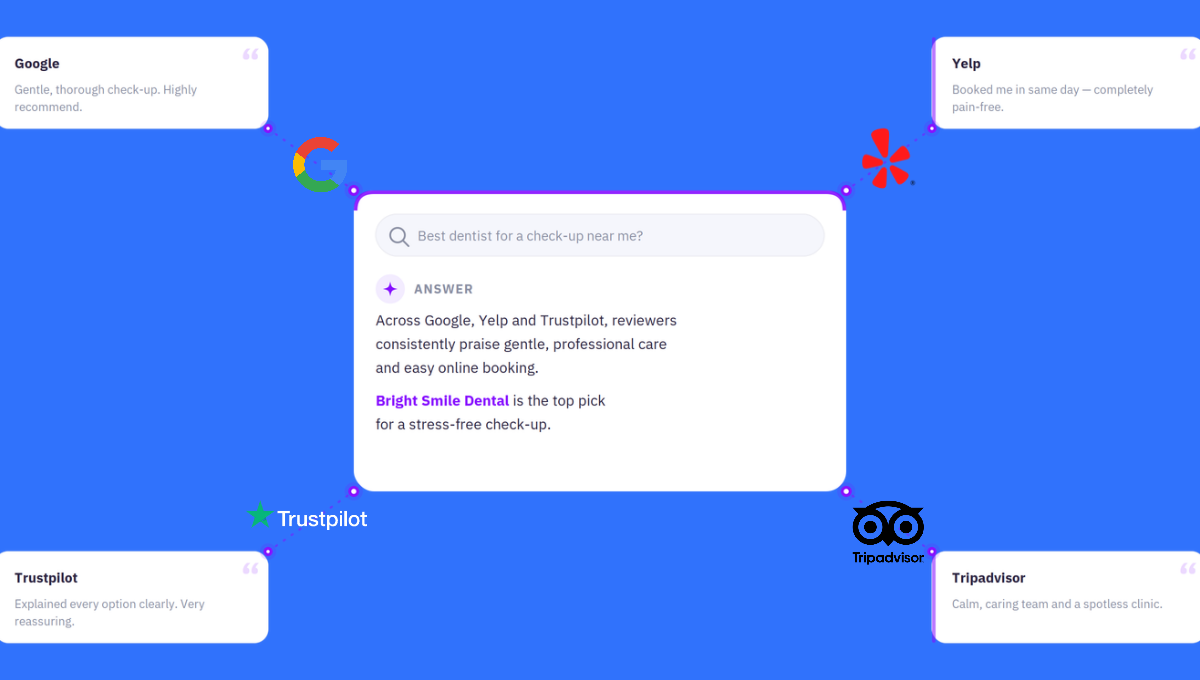
AI search models — ChatGPT, Gemini, Perplexity, Claude, Grok — don’t just check your Google reviews when someone asks "what’s the best emergency dentist near me?" They pull from multiple customer review platforms: Yelp, TripAdvisor, industry-specific platforms, social mentions, and structured data across directories. The wider you cast your review net, the more information AI systems have to recommend your business location to future customers.
After all, if all your reviews live on Google, an AI model has one data source to work with. If you have consistent, recent, responded-to reviews across Google and other credible platforms, the model sees corroborating signals from independent sources. Katya’s restaurant data proved it: Brands on zero platforms beyond Google had a 51.2% AI mention rate. At four platforms, that number jumped to 89.6%. It’s the clearest argument for review platform diversity we’ve come across.
These are the best review sites for local businesses based on consumer trust, AI model sourcing behavior, and Katya’s research. It’s worth noting that most of them are free review sites.
1. Google Business Profile
Google Business Profile is still the most important review platform for local businesses. Reviews feed directly into Local Pack rankings, Google Maps visibility, and AI Overviews. If you’re only managing reviews on one platform, this is the one.
Katya’s key finding: GBP review volume is the strongest AI visibility signal for dental and hotels. Mentioned dental practices averaged 643 Google reviews compared to 253 for those AI models never mentioned.
2. Yelp
Yelp remains the most influential review platform in the US and Canada for service businesses, restaurants, and local retail. Its strict review filter is aggressive — and rightly so: Consumers and AI models trust the reviews that come out the other side.
Yelp reviews also appear in Apple Maps business listings, though Apple has been gradually introducing its own native rating system alongside Yelp content. In July 2026, Yelp announced a data licensing agreement with OpenAI, giving ChatGPT direct access to Yelp’s 330 million reviews, ratings, photos, and business data when generating local recommendations.
Katya’s key finding: Yelp is the top AI visibility signal for restaurants (1,000+ reviews reaches a 93.3% mention rate) and grocery (500+ reviews reaches 100% mention probability).
3. TrustPilot
TrustPilot hosts more than 300 million active reviews globally and has strong consumer trust in the US and Europe. TrustPilot profiles frequently rank on page one for branded searches, which means AI models scraping search results pick them up even when users aren’t visiting TrustPilot directly.
Katya’s key finding: TrustPilot average ratings showed the highest correlation with AI mention probability of any review platform in the banking category. This makes it one of the few cases where a rating metric, not just volume, is a meaningful signal.
4. Facebook
Facebook has over 3 billion monthly active users, and recommendations on business pages are tied to real social profiles. That makes them harder to fake and easier for consumers to trust compared to anonymous review platforms.
Katya’s key finding: Facebook is the dominant social signal for mention probability in dental, where mentioned practices had 4.7 times more followers than nonmentioned practices. Facebook is also a strong frequency predictor in banking and hotels.
5. TripAdvisor
TripAdvisor hosts over 1 billion cumulative reviews and draws approximately 150 million average monthly visits. It is the dominant review platform for hotels and travel-related businesses, and its review content is widely indexed by AI models.
Katya’s key finding: TripAdvisor was cited as a source in 16% of Gemini's hotel responses, making it the highest-cited third-party platform for that model in the hotel category.
6. Bing Places
Bing’s direct search share is modest, but that understates its reach. Bing Places data feeds directly into Microsoft Copilot, which had over 100 million daily active users by mid-2025. When a Copilot user asks for a local recommendation, the AI answer draws on your Bing listing and reviews. Bing also powers a significant share of ChatGPT’s search-grounded answers, making it an AI visibility signal most brands forget about.
7. Instagram
Instagram is not a formal review platform, but user-generated content on the platform influences purchasing decisions — especially for categories where appearance matters, such as restaurants, retail, and hospitality.
Katya’s key finding: Instagram is the single strongest predictor of AI mention frequency for boutique hotels, with a stronger correlation than any GBP or editorial signal in that tier. Grok references Instagram content at the highest rate of any model, drawing on it in 21% of restaurant responses.
8. TikTok
TikTok is not a traditional review platform, but it is increasingly functioning as a local discovery channel. TikTok launched a location-based Local Feed in the US in 2026, surfacing nearby businesses based on a user’s real-time location. For restaurants, retail, and hospitality especially, creator-generated content functions as a visual review that shapes what consumers search for next.
TikTok was not covered in Katya’s AI visibility research, but it is worth monitoring as a discovery signal that feeds upstream demand.
9. Foursquare
Foursquare is no longer a consumer review platform. It has pivoted to an enterprise location data company, and its dataset of over 100 million points of interest feeds into Apple Maps, Uber, Snap, Microsoft, and other mapping services. You will not be managing customer reviews on Foursquare, but its data shapes how your business locations appear across the platforms that AI models read.
10. LinkedIn
LinkedIn is relevant for B2B businesses. Professional endorsements and company page reviews build credibility with enterprise buyers evaluating service providers.
Katya’s key findings: LinkedIn follower count for banks was the third-strongest social media correlation with AI mentions, behind Facebook and X. As with the other social platforms, follower count mattered more than simply having a profile.
The Most Important Industry-Specific Review Platforms
The general-purpose platforms cover the broadest ground, but industry-specific business review sites attract a different kind of reviewer — one who evaluates your business on criteria that rarely show up on Google.
An OpenTable reviewer rates food, service, and ambiance separately. A Healthgrades reviewer talks about bedside manner and wait times. A Booking.com reviewer zeroes in on room cleanliness and check-in experience. Each platform gives you unique insights into what customers actually care about.
This granularity is useful beyond reputation management: It’s the kind of location-level operational feedback that helps you fix specific problems at specific locations and helps AI systems understand what customers think about their experiences with you.
Tourism and Hospitality
Booking.com ties reviews to verified stays, so every review comes from someone who actually booked. The feedback tends to focus on room quality, cleanliness, and check-in logistics — operational details that help you improve specific locations. Booking.com review volume actually correlated negatively with AI mention probability for hotels, which means it’s valuable for operational insight but probably shouldn’t be your AI visibility strategy.
TripAdvisor is covered in the section above, but its role in hospitality deserves a second mention here. Reviews often include photos and detailed narratives that tell you more about the guest’s full experience than a star rating on Google ever will.
Viator matters for tour operators and experience-based businesses. Reviews include booking context, peak-time information, and visual content that helps travelers compare options — and Viator is owned by TripAdvisor, which means its review content is part of the same ecosystem AI models index.
Food and Beverage
OpenTable lets diners rate food, service, and ambiance as separate categories, giving you granular operational data you won’t get from a single Google star rating. Managing restaurant reviews across OpenTable and Google together shows you patterns you’d miss on either platform alone.
Healthcare
Zocdoc is absolutely worth mentioning here. Katya’s research found it was the only individual healthcare review platform to reach statistical significance for AI mention probability in the dentist category. If you’re a healthcare provider managing multiple locations, Zocdoc reviews should be a priority alongside Google.
Healthgrades is one of the most widely used doctor review platforms in the US, with patients rating providers on factors like bedside manner, wait times, and how well they explain conditions. For multi-location healthcare groups, maintaining accurate and responded-to Healthgrades profiles is critical.
Home Services
For consumers searching for the best websites for trusted service reviews, Angi is where they go when they’re ready to hire contractors, plumbers, electricians, and home service providers.
Multiple Reviews Across Multiple Locations Across Multiple Platforms — Oh My!
Yes, we want to hear clients throw multiple review platforms into conversations about where they’re managing reviews across locations. But we want to hear it with more intention and insight into which one really drives AI visibility.
If we could give you ten seconds of advice, based what we know about AI visibility, it would be this:
- Generate more reviews.
- Generate more reviews across more platforms relevant for your business type.
- Some review platforms influence bookings more than visibility. You need to know which ones influence AI visibility for your industry.
- Generate more reviews at the location level — i.e. listings on your reviews, not just your brand website.
- Manage your reviews from one platform instead of multiple that no one from your team has ownership over.
Next time your marketing lead pauses after "Google, then Yelp …" — they should know exactly what comes next, and why.


1,800 brands trust us to stay visible
— not just show up once or twice in local search.