Location, Location, Location: The Power of Store Locators (Analytics)
Store locators are an underutilized, yet impactful tool for local SEO. We showcase the benefits that it has on your business's bottom line.


In today's competitive landscape, businesses must leverage every available tool to ensure their success. One such tool that often goes underappreciated is the store locator on websites and mobile apps. This seemingly simple tool offers a myriad of benefits that can significantly impact a business's bottom line.
Let's explore why store locators are crucial for businesses—and then shed light onto two groundbreaking solutions: the Uberall Store Locator Analytics and Automated Image Optimization.
The Vital Role of Store Locators
The importance of store locators for businesses cannot be overstated. By prioritizing the implementation and optimization of store locator features, businesses can effectively leverage this tool to ultimately drive sustainable growth.
Convenience and Accessibility
Store locators provide customers with the convenience of finding physical store locations effortlessly. By simply inputting their location or preferences, customers can identify the nearest store, saving both time and effort. This accessibility fosters a positive customer experience by reducing friction in the purchasing process and increasing the likelihood of in-store visits.
Seamless Integration of Online and Offline Channels
In an era where omni-channel experiences are highly valued, store locators serve as a vital link between online and offline channels. Integrating a business's digital presence with its physical locations allows customers to transition effortlessly between the two. This not only enhances customer convenience but also strengthens brand cohesion and loyalty.
Increased Foot Traffic and Sales
A well-implemented store locator can drive significant foot traffic to physical stores. By providing accurate information about store locations and hours of operation, businesses can attract potential customers who prefer the immediacy and tangibility of in-person shopping. This influx of foot traffic boosts sales but also presents opportunities for upselling and cross-selling, further enhancing profitability.
Data Insights and Analytics
Beyond facilitating customer navigation, store locators also offer valuable insights through data analytics. By tracking user interactions with the feature, businesses can gain valuable insights into customer behavior, preferences, and geographic trends. This data-driven approach enables businesses to make informed decisions regarding store locations, marketing strategies, and customer engagement initiatives.
Store Locator Best Practices & Recommendations
Simply having a store locator on your website is not enough; optimizing it for maximum effectiveness is key. Here’s a few best practices from our customer base.
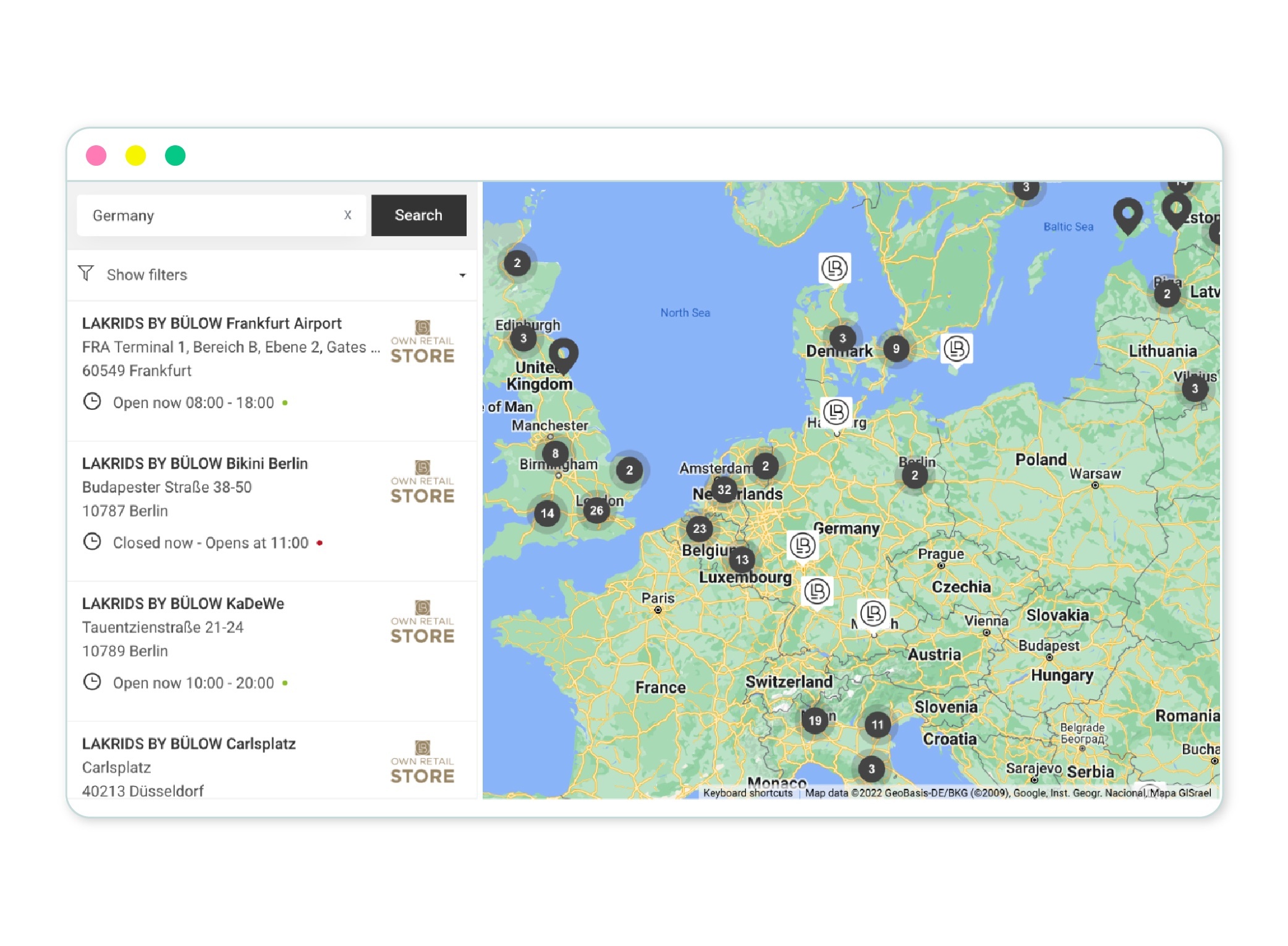
- Lakrids By Bülow built an intuitive locator with Uberall, allowing customers to easily find the nearest location on their company website with location-specific information and a clear path to purchase on local landing pages.
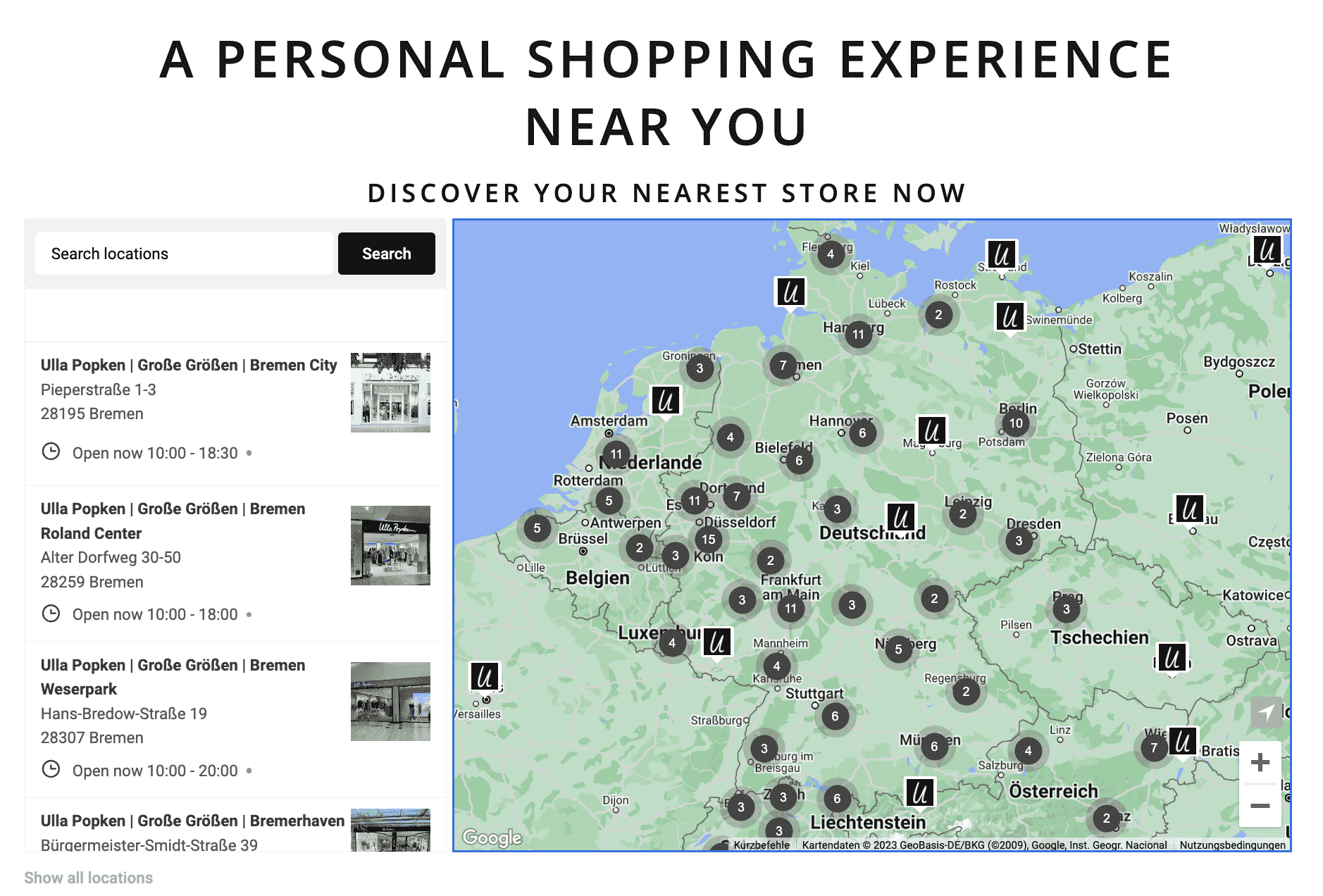
- Ulla Popken sends strong signals to customers and search engines alike with a store locator that is optimized for user experience with relevant local content like services, offers, and job vacancies.
Now let's move on to seven recommendations to ensure your locator’s effectiveness.
Store Locator Must Do's
#1 User-Friendly Design
First and foremost, prioritize a user-friendly design for your store locator. Ensure that it is easily accessible and prominently displayed on your website, preferably on the homepage or in the main navigation menu. Keep the interface clean and intuitive, allowing users to quickly input their location and find nearby stores without unnecessary hassle.
#2 Accurate Location Data
Accuracy is paramount when it comes to store locators. Make sure that the location data for each store is up-to-date and accurate, including addresses, phone numbers, and business hours. Nothing frustrates customers more than arriving at a location only to find that it's closed or doesn't exist.
#3 Mobile Optimization
Given the prevalence of mobile devices, it's essential to optimize your store locator for mobile users. Ensure that it is fully responsive and functions seamlessly on smartphones and tablets. Consider implementing features like geolocation to automatically detect the user's location and provide relevant results.
#4 Visual Mapping
Incorporate visual mapping features into your store locator to provide users with a more interactive experience. Utilize maps from reputable providers like Google Maps or Mapbox to display store locations visually. Allow users to zoom in/out, toggle between map and satellite view, and get directions to their chosen store.
#5 Integration with Reviews and Ratings
Integrate your store locator with customer reviews and ratings to provide users with additional information about each location. Display average ratings, read reviews, and view photos uploaded by other customers directly within the store locator interface. This helps build trust and credibility with potential customers.
#6 Real-Time Updates
Keep your store locator updated in real-time to reflect any changes in store locations, business hours, or other relevant information. Implement a system for store managers to easily update their information as needed, ensuring that users always have access to the most accurate data.
#7 Analytics and Tracking
Implement analytics and tracking tools to monitor the performance of your store locator. Track metrics such as the number of searches, clicks, and conversions generated through the locator. Use this data to identify areas for improvement and optimize the user experience accordingly.
Understanding the Customer Journey: The Power of Store Locator Analytics
Every interaction a visitor makes on your website holds a wealth of information waiting to be discovered. From tracing the origins of your traffic to monitoring the paths taken and actions performed, each click unveils vital insights. This understanding empowers businesses to tailor experiences, boost engagement, and ultimately, drive conversions. Yet, grappling with the complexities of extracting and interpreting this data has long been a challenge.
Enter Uberall's Store Locator Analytics—a game-changing solution designed to help businesses effortlessly gauge the performance and ROI of their store locator tools. No more grappling with cumbersome third-party analytics tools; now, insights into store locator performance are just a click away on the Uberall platform.

The intuitive platform provides businesses with a user-friendly interface to monitor unique clicks and conversions for their store locator, segmented by location and device. Such detailed analytics not only offer a comprehensive overview of user interactions but also pinpoint areas of strength and opportunities for enhancement.
Utilizing these valuable insights, businesses gain the ability to implement data-driven modifications to their store locator strategies, thereby ensuring effective alignment with the preferences of their target audience. Whether it involves optimizing user experiences based on device-specific information or customizing content to cater to distinct geographical areas. This, ultimately, leads to a more robust return on investment (ROI) and a heightened online presence, reinforcing the significance of local pages within the digital landscape.
The Significance of Image Optimization
In the pursuit of online prominence, the need for speed remains a pivotal yet often underestimated factor. Search engines continually prioritize websites offering not only relevant content but also swift, seamless user experiences.
Images that load swiftly enhance page speed directly influence SEO rankings. This is where image optimization emerges as a critical ally.
Recognizing the indispensable role of visuals, Uberall introduces an innovative solution: Automated Image Optimization. This feature elevates the visual appeal of your images and fine-tunes them for optimal performance to ensure they're not only captivating but also readily accessible to users.
Operating intelligently, the tool compresses image files without compromising their visual integrity, essential for enhancing your website's overall speed and responsiveness. By optimizing images for faster loading, Uberall's solution directly contributes to improving your website's SEO. A faster-loading site:
- secures higher search rankings
- delivers a superior user experience
- reduces bounce rates
- encourages deeper engagement with your content
Especially mobile users expect swift loading times and top-tier visuals, regardless of their internet speed or device. Automated Image Optimization ensures your website meets these expectations, rendering it more appealing and accessible to a wider audience.
High-quality, optimized images are more likely to attract potential customers, driving traffic to your site. They also contribute to a more immersive online experience, positively impacting conversion rates and customer retention.
With the introduction of Store Locator Analytics and Automated Image Optimization, Uberall propels businesses towards digital excellence. Ready to experience the impact? Reach out to the Uberall team.



1,800 brands trust us to stay visible
— not just show up once or twice in local search.